Singapore-India Hackathon 2026: 120 Students, AICTE Partnership and S$88,000 in Prizes
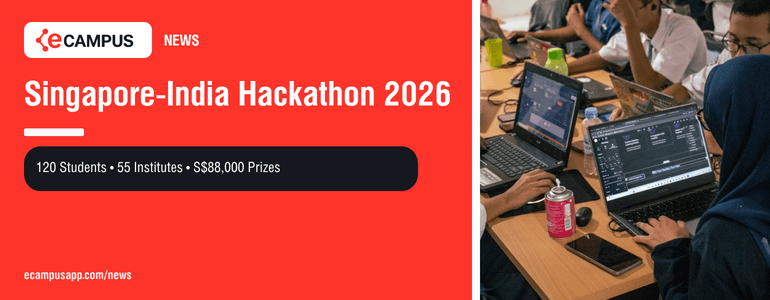
The fourth Singapore-India Hackathon brings 120 students from 55 institutions to SMU from November 15 to 17, 2026, with AICTE as co-organiser, S$88,000 in prizes and internship and scholarship pathways.
Some 120 students from Singapore and India spent this weekend building solutions to real problems set by companies and government agencies, at the fourth edition of the Singapore-India Hackathon. The event opened on November 15, 2026 at Singapore Management University (SMU) and runs until November 17, when winners in each of four tracks will be announced at 6 pm. Total cash prizes add up to S$88,000.
For Indian students, the hackathon is worth paying attention to for reasons beyond the prize money. It is co-organised by India's All India Council for Technical Education (AICTE) and the Ministry of Education's Innovation Cell, and it comes with internship, incubation and scholarship routes that participants can use long after the weekend ends. Here is what happened, who took part, and how students can position themselves for the next edition.
What is the Singapore-India Hackathon?
The Singapore-India Hackathon (SIH) is a joint student innovation competition between the two countries. The 2026 edition is organised by SMU's Institute of Innovation and Entrepreneurship (SMU IIE), AICTE and India's Ministry of Education Innovation Cell, in collaboration with TiE Singapore. It is held in consultation with the education ministries of both countries and the High Commission of India in Singapore.
This year's theme is "Build a Better Future". Students work in mixed-nationality teams over three days to design and pitch a working solution to a problem statement given by an industry or government partner.
Who took part
The 120 participants come from 55 institutes of higher learning across Singapore and India and were split into 20 teams. Every team includes students from both countries, so participants had to work across different academic backgrounds and working styles from day one.
Institutions named by SMU include IIT Kharagpur, Dayananda Sagar College of Engineering and Rathinam Technical Campus from India, and the National University of Singapore, Nanyang Technological University and SMU from Singapore. SMU did not publish the full list of participating Indian colleges, but the spread of names shows that teams were not drawn only from IITs. Students from private engineering colleges and smaller technical campuses also earned places.
Education ministers from both Singapore and India attended the opening as guests of honour, alongside AICTE Chairman Prof Yogesh Singh and AICTE Member Secretary Prof Shyama Rath. The judging panel includes Ravi Arora, Head of Group Innovation at Tata Sons, and Madhabi Puri Buch, former chairperson of SEBI.
The four tracks and problem statements
Each track has a sponsor that set a specific, practical problem. These are not abstract briefs. Each one describes a real gap the sponsor wants to close.
1. Emerging Technologies (Singtel)
Teams were asked how AI can help enterprise sales teams understand their customers better and recommend the next best action. This is a common business use of AI today, and it rewards students who can combine data skills with an understanding of how sales teams actually work.
2. FinTech and InsurTech (Income Insurance)
The challenge here was to use data and AI to make climate-risk insurance more affordable for vulnerable households and small businesses in Singapore. It mixes finance, climate risk and product design.
3. Sustainability and Climate Action (Singapore's Ministry of Trade and Industry)
This track focuses on Indian smallholder farmers. Teams had to show how technology can help small farmers meet the quality and reliability standards that large buyers, including importers in Singapore, expect. For Indian students who understand rural supply chains, this track was a chance to use local knowledge as an advantage.
4. Social Innovation and Inclusive Development (raiSE)
Set by the Singapore Centre for Social Enterprise, this track asked for solutions that help lower-income and disadvantaged seniors in Singapore and India age well and stay engaged with their communities.
What participants get beyond the prizes
The S$88,000 prize pool gets the headlines, but the longer-term benefits may matter more for most participants.
Industry networking and internships
A talent networking session brings participants face to face with more than 10 companies, including GIC, Singapore Airlines, Singtel and Temasek. These companies are offering projects, internships and job opportunities. For a final-year engineering or business student, a conversation at this kind of event can be worth more than a dozen online applications.
Incubation support
Teams that want to keep building their idea after the hackathon can continue with SMU IIE's Business Innovations Generator (BIG) incubator. That gives promising projects mentoring and a path toward becoming an actual startup.
A new postgraduate scholarship
SMU has announced the Nupur A. and Amrish Bahadur Scholarship, which will fund four SIH participants or alumni to study a postgraduate programme at SMU. It is open to participants from any of the three past editions, of any nationality. Eligible programmes include the Master of IT in Business, the Master of Science in Business AI and the Master of Science in Entrepreneurship and Innovation.
Students who took part in earlier editions should check SMU's website for application details, since the scholarship is not limited to this year's teams.
Why this matters for Indian higher education
AICTE's involvement means the hackathon fits into a wider push to give Indian technical students exposure to real problem-solving, industry mentors and international peers. India already runs large national hackathons, such as the Smart India Hackathon, and the Singapore-India edition adds an international layer on top.
For students, the main lesson is that employers and universities increasingly look for proof that you can build something, work in a team and present your work clearly. A hackathon result is one of the few things on a CV that shows all three at once.
It also shows a shift in which skills are in demand. Three of the four tracks this year centre on AI and data. Students who combine a core degree, whether engineering, commerce or social science, with practical AI and data skills are better placed for events like this and for the jobs that follow.
How to prepare for the next Singapore-India Hackathon
Selection details for future editions will come through AICTE and the Ministry of Education Innovation Cell, so keep an eye on their official channels and on your college's innovation or IIC (Institution's Innovation Council) cell. In the meantime, here is how to build a profile that stands out:
Take part in domestic hackathons first. The Smart India Hackathon, college fests and company-run challenges give you practice in building and pitching under time pressure.
Build a small portfolio. Two or three projects on GitHub, or a short case study, show selectors what you can actually do.
Learn the basics of AI tools and data analysis. You do not need to be an expert, but knowing how to use Python, a spreadsheet model or an AI API quickly is a real advantage.
Practise pitching. Teams are judged on how clearly they explain the problem and their solution in a few minutes, not only on the code.
Work with people outside your branch. The best teams mix technical, business and design skills.
Can online degree students take part?
Hackathons like this are usually open to students enrolled in recognised higher education institutions, and selection runs through AICTE-linked colleges and innovation cells. If you are studying an online degree, check whether your university has an innovation cell or IIC, and ask whether it nominates students for national and international hackathons. Online learners can also build the same portfolio of projects and domestic hackathon results that selectors look for.
Frequently asked questions
When is the Singapore-India Hackathon 2026?
It runs from November 15 to 17, 2026 at Singapore Management University, with winners announced on the evening of November 17.
Who organises the Singapore-India Hackathon?
SMU's Institute of Innovation and Entrepreneurship, AICTE and India's Ministry of Education Innovation Cell, in collaboration with TiE Singapore.
How many students took part in 2026?
120 students in 20 teams, from 55 institutions in Singapore and India.
What is the prize money?
S$88,000 in total cash prizes across four tracks.
Is there a scholarship for participants?
Yes. The new Nupur A. and Amrish Bahadur Scholarship will fund four past or present SIH participants to study a postgraduate programme at SMU.
This article is based on Singapore Management University's announcement of November 15, 2026. We will update it once the winning teams are announced. Follow eCampus for more news on student opportunities, hackathons and higher education.