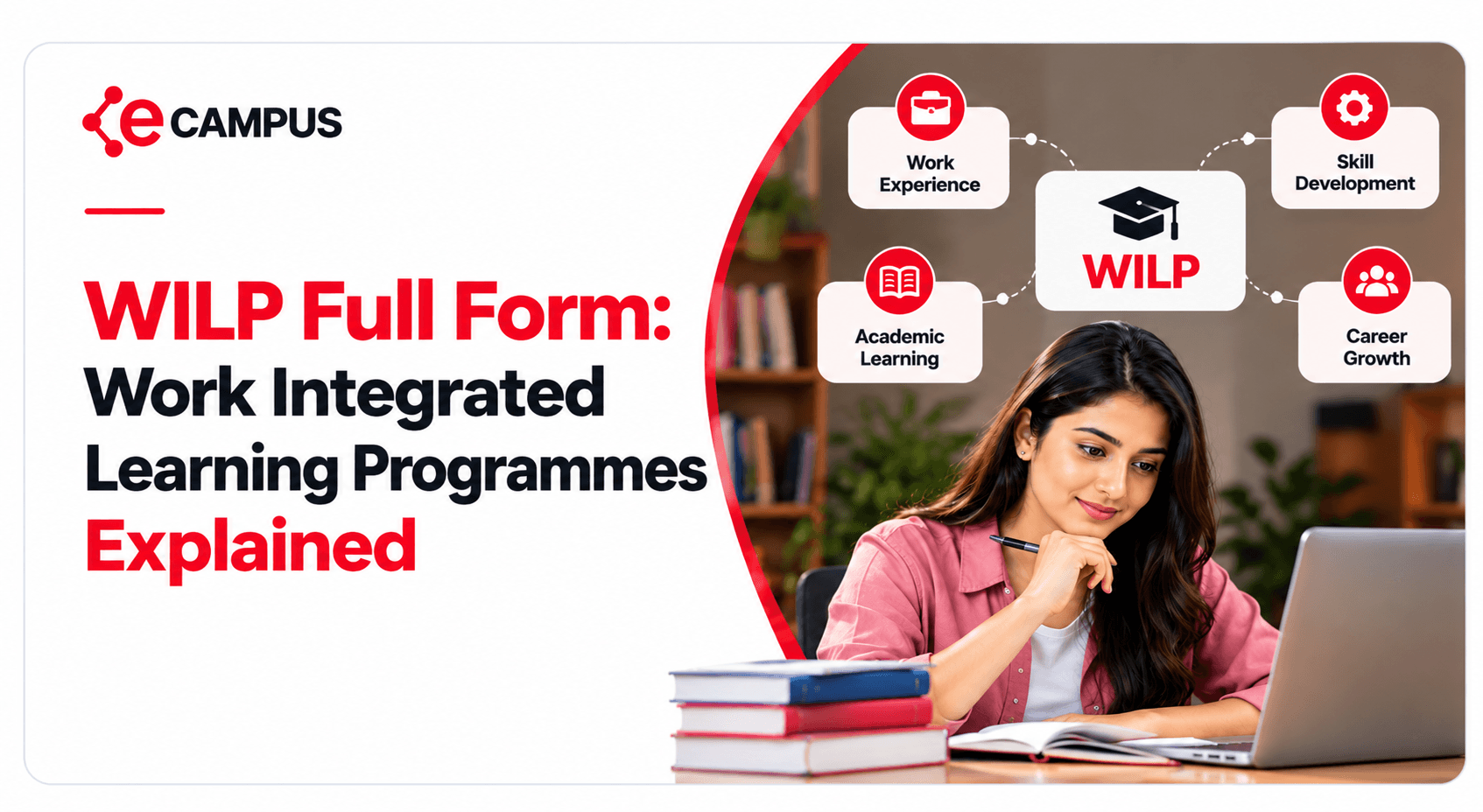
WILP Full Form: Work Integrated Learning Programmes Explained
8 min read listen • Voice narration
WILP stands for Work Integrated Learning Programmes. These programmes are designed to help working professionals continue their education while gaining practical knowledge that can be applied to their jobs. Instead of leaving employment to pursue further studies, eligible professionals can upgrade their qualifications while continuing their careers.
WILP is particularly relevant for employees in engineering, information technology, manufacturing, management, and other technical fields. The learning approach combines academic concepts with workplace applications, helping students connect what they learn with real professional challenges.
BITS Pilani is one of the well-known institutions offering Work Integrated Learning Programmes for employed professionals. Its programmes include options in engineering, technology, management, and other specialised areas.
What Is the Full Form of WILP?
The full form of WILP is Work Integrated Learning Programmes.
Particular | Details |
|---|---|
Full Form | Work Integrated Learning Programmes |
Main Purpose | Education alongside employment |
Target Audience | Eligible working professionals |
Learning Approach | Academic learning with practical application |
Popular Areas | Engineering, IT, Technology, Management |
Study Format | Online and technology-enabled learning, depending on the programme |
Key Benefit | Upskilling without necessarily leaving a job |
WILP is not simply another name for a regular online degree. It is an educational approach that connects learning with professional experience and workplace requirements. The exact format, eligibility, and qualification depend on the institution and programme.
What Are Work Integrated Learning Programmes?
Work Integrated Learning Programmes allow eligible employees to pursue higher education while remaining professionally active. The knowledge gained through coursework can be applied to workplace projects, technical tasks, and business challenges.
For example, an engineer working in manufacturing may pursue a higher qualification to develop expertise in production systems or engineering technology. Similarly, an IT professional may choose a specialised programme to improve knowledge of data science, cybersecurity, or software systems.
The main idea is to make education relevant to the learner's existing work and future career goals.
At BITS Pilani, WILP programmes combine academic instruction with workplace learning, industry-oriented assignments, and practical applications. Certain programmes also require employer support and a workplace mentor, depending on the applicable programme rules.
Key Features of WILP
1. Education Alongside Employment
One of the major advantages of WILP is the opportunity to continue working while studying. This can help professionals upgrade their qualifications without taking a complete career break.
2. Industry-Relevant Curriculum
WILP programmes are designed around professional requirements. Depending on the course, students may study technical concepts, management practices, emerging technologies, and specialised industry subjects.
3. Practical Learning
Students can connect academic concepts with real workplace problems through assignments, projects, case studies, and practical exercises.
4. Flexible Learning Methods
Many programmes use online lectures, recorded learning resources, virtual classrooms, and digital study materials. However, the exact delivery method depends on the institution and course.
5. Professional Skill Development
WILP can help learners strengthen technical knowledge, analytical thinking, problem-solving, and professional capabilities relevant to their current or future roles.
6. Career Progression
Additional qualifications and relevant skills may help professionals prepare for specialised roles, increased responsibilities, or internal career opportunities. Career advancement is not guaranteed and also depends on experience, performance, and employer requirements.
WILP Courses and Programmes
The programmes available under WILP vary by university. BITS Pilani's Work Integrated Learning division offers programmes in areas including engineering, technology, management, and specialised professional education.
Some common programme categories include:
Programme Category | Suitable For |
|---|---|
B.Tech or Engineering Technology | Eligible diploma holders and professionals seeking engineering qualifications |
M.Tech | Professionals seeking advanced technical expertise |
MBA | Working professionals interested in management and leadership |
M.Sc | Learners seeking specialised scientific or technical knowledge |
Postgraduate Diplomas | Professionals seeking focused subject expertise |
Certificate Programmes | Learners developing specific professional skills |
These categories are illustrative, not a guarantee that every programme is available in every admission cycle. Applicants should check the current offerings and eligibility requirements of their chosen institution.
WILP Eligibility Criteria
WILP eligibility depends on the university, course, previous qualification, and relevant work experience requirements.
For programmes designed specifically for employed professionals, applicants may need to meet the following conditions:
Hold the required educational qualification.
Have relevant work experience where specified.
Be employed at the time of application, if required.
Work in a field related to the selected programme, where applicable.
Provide employer endorsement or support if the programme requires it.
Submit academic and employment documents for verification.
BITS Pilani's WILP academic guidelines specify that eligibility can include relevant employment, prescribed academic qualifications, work experience, and employer support. Requirements vary by programme.
Students should not assume that every WILP course requires the same level of experience or the same educational background.
WILP Admission Process
The admission process usually involves checking eligibility, selecting a programme, submitting an application, and completing document verification.
Step 1: Choose a Programme
Identify the course that matches your qualifications, work experience, and career goals.
Step 2: Check Eligibility
Review the programme's academic requirements, experience criteria, and any employer-related conditions.
Step 3: Complete the Application
Fill out the application form with the required personal, academic, and professional details.
Step 4: Submit Supporting Documents
Depending on the programme, documents may include academic certificates, marksheets, employment proof, identification, and employer endorsement.
Step 5: Complete the Selection Process
Follow any applicable assessment, verification, or admission requirements specified by the institution.
Step 6: Confirm Enrollment
After receiving admission confirmation, complete the remaining formalities and review the academic calendar and learning requirements.
Always follow the current admission instructions published by the university, as processes can differ between programmes and admission sessions.
WILP vs Regular Degree Programmes
WILP and conventional degree programmes serve different learner needs. WILP is particularly relevant to eligible working professionals, whereas regular campus programmes may be more suitable for students who can attend college full-time.
Factor | WILP | Regular Campus Programme |
|---|---|---|
Target Learners | Primarily working professionals | Students and other eligible applicants |
Employment | Designed to accommodate employment | May require substantial campus attendance |
Learning Style | Work-related and academic learning | Classroom, laboratory, and campus learning |
Practical Application | Often connected with workplace projects | Depends on the curriculum and practical components |
Flexibility | Designed around professional commitments | Depends on the institution and timetable |
Eligibility | Programme-specific, sometimes requiring employment | Programme-specific |
The qualification, recognition, duration, assessment methods, and academic standards depend on the university and programme. Students should verify these details rather than assuming that all WILP courses follow identical rules.
Benefits of WILP for Working Professionals
Learn Without Taking a Career Break
Professionals can continue earning while pursuing further education, provided their programme permits them to balance both commitments.
Apply Knowledge at Work
Learning becomes more relevant when students can connect concepts with workplace projects and real business or technical problems.
Improve Technical Expertise
WILP can help professionals update their knowledge in areas such as engineering, technology, analytics, manufacturing, and management.
Prepare for Greater Responsibilities
A relevant qualification may support applications for specialised positions, team leadership, or career progression within an organisation.
Develop a Professional Network
Depending on the programme, students may interact with faculty members, classmates, industry mentors, and other working professionals.
Is WILP a Good Option in 2026?
WILP can be a suitable option in 2026 for professionals who want to strengthen their qualifications while continuing their careers. It may be particularly useful for employees who want to develop advanced technical skills, move into specialised roles, or prepare for management responsibilities.
However, choosing a WILP programme requires careful research. Students should check the institution's status, the specific qualification awarded, programme eligibility, duration, study format, assessment requirements, and employer-support conditions.
It is also important to consider your workload. Balancing employment with assignments, examinations, and project work requires consistent time management.
Conclusion
WILP stands for Work Integrated Learning Programmes, an educational approach designed to connect academic learning with professional experience. It provides eligible working professionals with opportunities to upgrade their knowledge and qualifications while continuing their employment.
WILP programmes may be available in engineering, technology, management, science, and other specialised fields, depending on the institution. Their main advantages include practical learning, industry relevance, and the opportunity to apply new knowledge in the workplace.
Before applying in 2026, review the eligibility criteria, recognition, course structure, learning format, and qualification details of your chosen programme. The right WILP course can support professional development when it aligns with your career goals and you can manage the academic workload alongside your job.
FAQs
1. What is the full form of WILP?
WILP stands for Work Integrated Learning Programmes.
2. What is the main purpose of WILP?
Its purpose is to help eligible professionals combine academic learning with practical workplace experience and develop relevant skills while continuing their careers.
3. Who can apply for WILP?
Eligibility depends on the programme. Applicants may need a specified educational qualification, relevant work experience, current employment, or employer support.
4. Is WILP only for working professionals?
WILP programmes are generally designed for working professionals, although the exact eligibility requirements depend on the institution and course.
5. Which university is known for WILP programmes?
BITS Pilani is a well-known institution offering Work Integrated Learning Programmes in engineering, technology, management, and other specialised areas.
6. What courses are available under WILP?
Depending on the institution, options may include B.Tech, M.Tech, MBA, M.Sc, postgraduate diplomas, and certificate programmes.
7. Can I pursue WILP while working full-time?
Many WILP programmes are designed to accommodate employment. However, students must manage the required lectures, assignments, assessments, and projects alongside their work.
8. Is WILP the same as distance education?
Not necessarily. WILP specifically connects academic learning with professional work, while distance education generally describes a mode of delivering education. The structure and requirements vary by programme.
9. Does WILP guarantee a promotion or salary increase?
No. A WILP qualification may support career development, but promotion and salary growth depend on several factors, including skills, experience, performance, and employer policies.
10. What should I check before enrolling in WILP?
Check the university, qualification awarded, eligibility criteria, employment requirements, recognition, curriculum, duration, learning format, assessment process, and current admission rules.